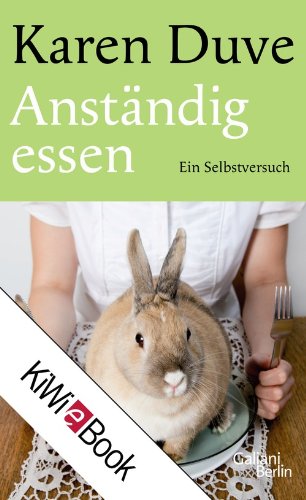
Lately I have not had much time patience to sit down and actually read a book. Although I have plenty of literary adventures waiting for me in my bookshelf it took me ages to return into my evening reading habit. And this book written by Karen Duve.
Being a little bit more aware of what I eat, I thought it could not harm to read a book around the topic of food ethics. The teaser indeed holds its promise to inform about the authors' self-experiment of changing her lifestyle: She asked herself whether a morally correct nutrition is possible - without spamming the reader with all kind of accusing and preaching.
The plot:
In a fun and self ironic way she writes her story of becoming more aware of what she eats and the according life style:
Phase 1: Bio
First she starts her journey and buys only bio-labelled products, you know those small labels looking like a stop sign. She bought her products at a regular supermarket, at discounters, and occasionally in bio-supermarkets. Later on in her bio-phase she switches to only buy in the latter ones, to support regional food producers. The shopping in bio-supermarkets require a higher investment than the grocery shopping at regular tesco's/rewes/ albert heijns, she talks about 30 % more necessary budget if the eating habits stay the same as before (talking sweets, meat etc). She did not notice any change in weight.
In this chapter she also emphasizes on the methods of industrial farming and only enjoys her meat grown at certified Demeter farms.
Phase 2: Going vegetarian
In the second phase Ms Duve is switching to vegetarian food. She continues to buy her products in bio-supermarkets only. Even though she is a meat lover she does not find it super-difficult to leave out meat and switch to vegetarian dishes. Vegetarian means a meat less nutrition where eggs, milk and related products are allowed, fish and gelatin count as animal-products and cannot be eaten while practicing this life style. In this phase it is all about not killing animals for food and starting to engage in animal rights issues. Over two months she practiced the Vegetarian life style and resumes that there are not that many changes / efforts the to undertake. While Ms Duve expected some significant weight loss (in her case very much welcomed) it turned out to be the opposite: +4 kilograms after 2 months of vegetarian food.
Phase 3: Go vegan
After that the real change began: 3 vegan months lay before the author to try out this lifestyle practiced by a minority of people. Vegan lifestyle involves the abandonment of all food which is or is made of animals: No more dairy, eggs, meat, game, fish and anything which is made of these. Ms Duve even went that far that she abandoned duvets, things made from wool and leather which also involved clothes. Good bye boots, belts and all kind of pullovers. Also honey is not allowed on the menu anymore as this is considered as bee exploitation. During this phase she kept on researching about animal rights, animal keeping methods and participated in a hen-freeing mission. She investigated further into methods such as hunting: Here she found out that the hunters argue as follows: The have to shoot a certain quota of animals (let it be deer / boars etc) to ensure a healthy forest. Strangely enough (for the hunters society) she also found out that they not only shoot harmed or ill animals to keep the numbers decent. It seems that forest workers even have to provide extra food over the winter to get a solid amount over the frosty season, which allows the conclusion that natural selection would ensure exactly this solid number without any human intervention. Interesting.
While the author noticed a gain of weight in the last phase, she lost about two kilos in her vegan period. Her blood values remained good throughout the time.
Phase 4: Fruitarian
Last but not least she turned towards fruitarian nutrition. That is a difficult step for her. Not being able to integrate anything like dairy into the diet is already hard enough, but sticking to fruit and vegetable which did not kill the whole plant must be almost impossible. This lifestyle allows all fruit and nuts which are volunteerly provided: Apples, bananas, grapes, peas, beans, nuts, pumpkins, coconut milk etc. Not allowed are: crop, carrots, potatoes etc. During her writing process she tried vehemently to find interview partners who are practicing this lifestyle, but these people seem to be very rare. She reported 10 kilos weight loss during two months of fruitarianism.
In the end she has to take a decision on how to proceed her life. She states that it is quite difficult to know and not act accordingly. She admits that she will not live completely vegetarian but reduce her meat and dairy consumption down to 10% of what she had consumed before. She committed to live much more attentive to what she buys and what she eats to make a contribution. She realized she might not be influence others but at least she is able to influence herself.
My personal thoughts to the book:
In a nutshell this book is a combination of information load and humor packed autobiographic piece. The author invites us into her life - together with her flat mate, two cats, a horse, 2 mules, a dog and a couple of freed hens. A quick read about what we eat, the opportunities and difficulties of different life styles, information on climate change, animal ethics and farming methods, showing of different points of views and helpful suggestions. It is not a book full of moral preaching as one might expects from covering such a topic but definitely for people with an open mind for future change.
In the end everyone has to make their own decisions of what they eat. But the point is to make a decision, to have an actual reason to do it this way or the other rather than just adopting something only because it has always done like this, or because supermarkets provide it.
Being a vegetarian it is easy to recommend this book. It is a quick and easy, well-researched read for everyone who is ready for a change, or at least prepared to consider a change.
Personally I would like to adopt a vegan life style for health and ethic reasons, but I know that I would not be able to live without eggs and dairy at this moment.
My personal contribution is to continue buying my eggs at the demeter farm 2 kilometers from my place and stick to bio products in general as I assume its production went with a more attention to ethics.
With dairy products in general I am not that good right now: I do eat low fat yoghurt. A lot. And I like love cheese. I often replace regular yoghurt with soy yoghurt and milk as I absolutely prefer its taste (not as sour as proper yoghurt)but it is quite costly too.
I also try to buy as much as possible in bio-shops and local farm shops.
I am try to work on improving my lifestyle to a more ethic one continuously. I used to make exceptions with fish occasionally (once a month or so) but I am not such a fish-lover anyways.
How about you? Any veggie around here ;-)?
And how about your latest read? Anything you recommend?
Happy reading!
Love,
Svenja
xx